Radiantcapital entered DAO wind-down while preserving access to lending contracts
Radiantcapital is a DeFi money market whose DAO entered DAO wind-down while preserving contract access for existing lending positions. The June 1, 2026 plan stopped active development and disabled new borrowing across Core and RIZv1 markets. Existing users retained options for repayments, withdrawals, reward vesting and dynamic liquidity provisioning (dLP) management, subject to their positions’ conditions and reduced operational support.
The change left outstanding loans, accrued rewards and exploit-related claims with different practical consequences. Repayment reduced an existing loan, while exploit remediation depended on eligibility and available funding, including any recovered assets. An unfinished expansion also carried different expectations from infrastructure that Radiant had already introduced.
The short version: The June 2026 maintenance commitment preserved existing-position access without promising further upgrades, patches or operational intervention.
Existing contracts and stopped development
June 1, 2026 marked the end of active development, alongside a gradual reduction in DAO operations. The maintenance phase preserved deployed contracts so users could manage positions that already existed. Before the wind-down, Radiant’s omnichain money-market model used LayerZero and targeted deposits and borrowing across networks. Lenders supplied assets to earn market interest; borrowers obtained liquidity against collateral without selling their holdings. The DAO limited administrative actions to critical functions and stopped pursuing new initiatives. The Radiant V2 sunset reference kept deposits, liquidations, reserve-fee accrual and RDNT cross-chain transfers operational. The DAO stopped new market expansion and feature development.
Withdrawals, repayments and existing balances
Withdrawals and loan repayments remained among the actions that the maintenance plan preserved. Users could also manage or close existing lending positions through deployed contracts.
Repayment reduced an existing loan’s debt. Withdrawal required sufficient unborrowed liquidity and compliance with any collateral requirements for remaining debt.
Existing RDNT vesting positions continued to mature, and already-funded reward streams remained available under their distribution schedules. Early withdrawal of unvested RDNT could incur a penalty under the applicable vesting rules.
dLP tokens represented liquidity in pools pairing Radiant’s RDNT token with assets such as ETH or BNB. Before the wind-down, locking dLP supported RDNT incentive eligibility, protocol-fee sharing and governance voting. Existing locks kept their release schedules, and expired locks could be withdrawn without penalty. Releasing a dLP lock returned the liquidity token; redeeming its underlying assets involved exiting the relevant pool.
The plan encouraged position closure and lower exposure as the DAO reduced its operations.
Could users open new loans during the wind-down?
The June 1, 2026 wind-down plan disabled new borrowing across Core and RIZv1 markets. The restriction concerned new loans in those named markets. Existing-position functions stayed within the maintenance scope. The continuing accessibility of lending contracts did not establish that a new borrowing action remained available.
The June plan called for RDNT emissions to stop. Emissions concerned new token incentives; vesting and withdrawal addressed existing rewards.
The 2024 incidents and shrinking reserves
The January 2024 flash-loan attack involved approximately 1,900 ETH. The DAO subsequently used treasury funds to settle the resulting communal bad debt after a governance vote. That response substantially reduced the reserves available for later operations.
October 2024 brought a separate exploit exceeding $50 million. The June 2026 wind-down announcement reported unresolved remediation for affected users. The losses also harmed participation: declining trust and retention, together with slower user acquisition, reduced engagement and revenue. Rebuilding the protocol did not restore a sustainable operating runway by itself.
By June 2026, the DAO had secured no new external investment or grants that could re-establish viable operations. These constraints persisted despite the protocol rebuild and the launch of dozens of new markets. The DAO ended active development under those conditions, while reserving its remaining resources for essential operations and recovery.
RIZv2 integration and undelivered expansion
Radiant integrated Morpho’s isolated-market infrastructure as RIZv2 during its post-exploit rebuilding phase. The integration supported work on scalability and risk segmentation. Core markets used shared pools and cross-collateralization. RIZv2 separated each collateral/loan-asset pair’s liquidity and risk parameters, without sharing liquidity with Core or other isolated markets. The broader expansion remained unfinished at the June 2026 announcement.
The unfinished work included 150 or more planned isolated markets under RIZv2 and vault infrastructure for that version. Other undelivered plans covered a bribing and incentive system, allocator onboarding pathways and cross-chain capital efficiency improvements. These extensions would have broadened Radiant’s product range. Active development stopped before the DAO delivered them, so they remained outside the completed offering described in the wind-down plan.
What role did the Guardian Fund play?
The Guardian Fund was Radiant’s protocol-native component for capital protection and loss management. Radiant introduced it during the rebuilding phase, while expanded Guardian Fund architecture remained unfinished at the June 2026 announcement. GuardianLP (gLP) represented reserve capital that could earn yield but lose value when used for qualifying remediation. Coverage depended on eligibility, DAO rules and available assets; user errors and ordinary market-price losses were excluded. The June 2026 announcement still reported unresolved remediation for October 2024 victims.
What happened to the recovery effort?
Recovery efforts continued after active development stopped, within the limits of the DAO’s remaining resources. The June plan committed to keeping the remediation portal live indefinitely and directing any recovered assets to affected users. The portal documented its Phase II claim interface as live on December 3, 2025. The remediation plan covered lending-market deposit losses and listed protocol revenue and DAO resources among its funding sources. It excluded unlimited-allowance wallet drains after a separate proposal failed quorum; future governance votes could revisit that exclusion. A live interface alone did not guarantee claim funding, full repayment or a payment date.
zeroShadow’s involvement continued within available resources, alongside forensic tracking and monitoring of exploited funds. By June 1, 2026, zeroShadow had recovered none of the funds lost in the October 2024 exploit.
Recovery updates on X carried an indefinite continuation commitment. A small contributor group retained essential claims and recovery work within reduced operating capacity.
Matching a position to the remaining functions
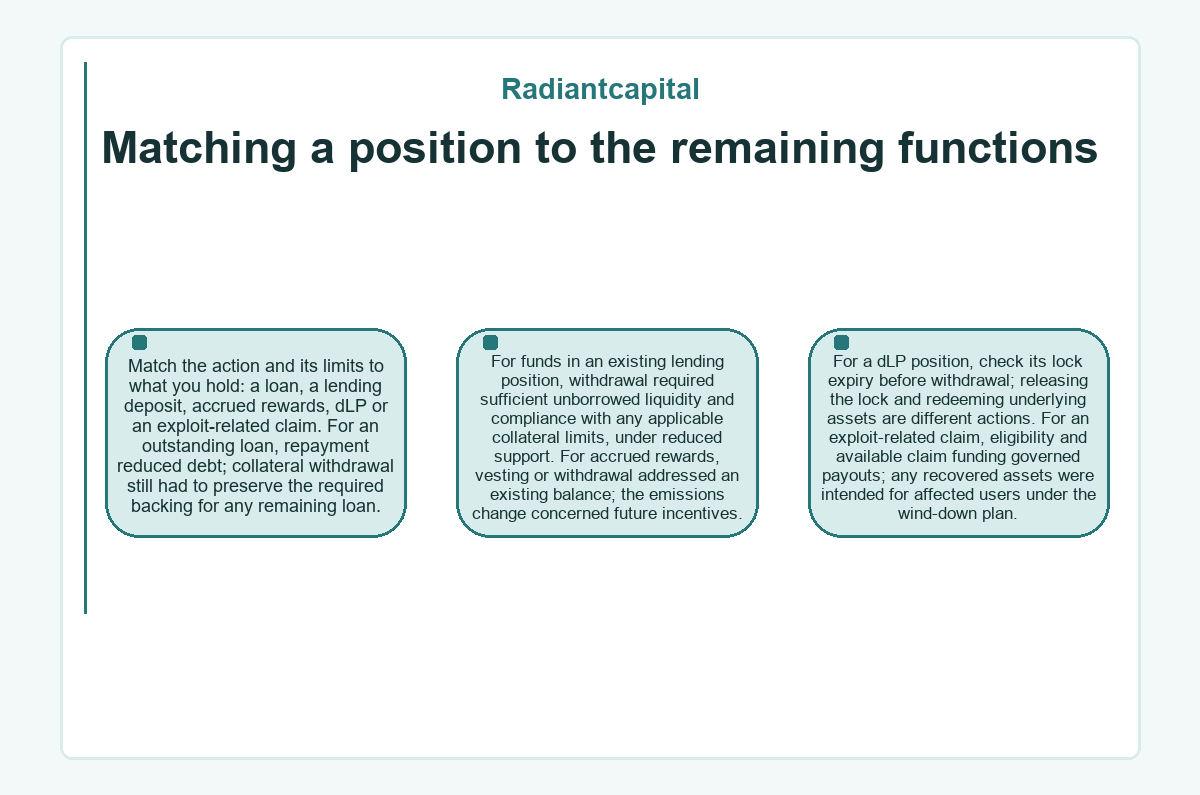
Match the action and its limits to what you hold: a loan, a lending deposit, accrued rewards, dLP or an exploit-related claim.
- For an outstanding loan, repayment reduced debt; collateral withdrawal still had to preserve the required backing for any remaining loan.
- For funds in an existing lending position, withdrawal required sufficient unborrowed liquidity and compliance with any applicable collateral limits, under reduced support.
- For accrued rewards, vesting or withdrawal addressed an existing balance; the emissions change concerned future incentives.
- For a dLP position, check its lock expiry before withdrawal; releasing the lock and redeeming underlying assets are different actions.
- For an exploit-related claim, eligibility and available claim funding governed payouts; any recovered assets were intended for affected users under the wind-down plan.
Reduced support and continuation requirements
Through the end of 2026, the wind-down plan committed to keeping the front end, documentation and community support channels available. Discord and Telegram formed part of that reduced support arrangement. The plan called for website chat to end immediately. The different service commitments mattered because an indefinite recovery effort did not extend every support channel on the same terms.
Deployed contracts remained immutable and accessible on-chain as operational intervention decreased. The plan offered no assurance that all functions would behave as originally intended under every condition. Users could not assume further upgrades, patches or interventions.
A community-led continuation could change the operating direction, subject to the conditions set for using the Radiant name. Any formal proposal needed governance alignment and a credible operating, security and risk framework. It also had to meaningfully address users affected by the October 2024 incident.
Popular questions about Radiantcapital
What replaced Radiantcapital’s founder-led governance?
A community-elected council replaced the founder-led governance structure after the 2024 incidents. The DAO narrowed its mandate toward security, recovery, remediation and user support, with limited capacity for new development. This governance transition preceded the June 2026 wind-down, while recovery and funding constraints persisted.
Did the Radiant Capital Foundation also close during the DAO wind-down?
The Radiant Capital Foundation remained in existence during the DAO wind-down. It retained stewardship of the Radiant brand, trademarks and associated intellectual property. A community group proposing to use those assets for a continuation, rebuild or commercialization effort needed to initiate contact through official community channels, alongside the operating and governance requirements for a formal continuation.
How could recovered funds reach affected users?
Claim contracts or Merkl remained distribution mechanisms for funds that might be recovered. The remediation portal and claims infrastructure had continuing maintenance commitments, and the plan intended recovered funds for affected users. These routes did not establish that stolen assets had been recovered or guarantee a payment amount or date; eligibility and available claim funding still governed payouts.
Could DAO contributors still receive compensation during the wind-down?
The wind-down plan allowed reasonable contributor compensation directly tied to essential operations. Those operations included user support, maintenance of the remediation portal and claims infrastructure and continued engagement with zeroShadow. The treasury restriction connected compensation to this reduced mandate rather than funding new expansions, feature development or an unrestricted program of contributor work.
Why could January’s bad debt be settled while exploit recovery remained unsuccessful?
The DAO settled January 2024’s communal bad debt using treasury funds after a governance vote. That action covered the contract’s bad debt from remaining reserves, independently of recovering stolen assets. By June 1, 2026, zeroShadow had made no meaningful recovery from either 2024 attack.
Updated -