Radiantcapital platform fee claims credited rTokens that required redemption into underlying assets
Radiantcapital platform fee claims credited rTokens, the interest-bearing tokens that represented assets in its lending markets. Converting those balances into the underlying assets required withdrawal under the pool’s liquidity and collateral rules. The June 1, 2026 DAO wind-down preserved withdrawal access while ending active development, so a fee claim and an asset payout remained different outcomes.
Locked Dynamic Liquidity Provisioning (dLP) positions earned platform revenue. Claiming credited rTokens representing a lending balance; redemption moved available assets out of the pool. RDNT reward vesting and exploit remediation followed different rules, even though both also involved claims.
Key takeaway: Radiant V2 retained platform fee distribution when new RDNT emissions stopped. Separate contracts handled the two reward flows.
Locked dLP and the revenue available to claim
Locked dLP gave participants a share of platform fees, which created claimable revenue in Manage Radiant. It was separate from the liquidity tokens that the holder had locked. Claiming revenue therefore concerned earnings from a dLP position; unlocking or withdrawing dLP concerned the position itself. A claimable fee balance did not establish that the liquidity tokens had reached their unlock date. The wind-down plan retained both reward-management and dLP-withdrawal functions, with their own conditions.
Platform revenue described earnings distributed to dLP holders. It did not describe a charge that holders paid for claiming those earnings.
What did Claim All put in the wallet?
A completed platform-revenue Claim All operation credited fees as rTokens in the wallet. Those tokens represented an interest-bearing lending balance. The underlying asset remained in the money market until withdrawal. The claim control belonged to the platform-revenue area of Manage Radiant, where locked dLP holders could view their claimable earnings.
rToken balances and underlying assets
rTokens identified interest-bearing balances in the money market, while withdrawal returned the underlying assets.
The asset behind the token label
The USDC representation used the name rUSDC. It identified the underlying asset without showing how much unborrowed USDC the pool held.
Retaining the lending balance
Holding claimed rTokens in the wallet continued the holder’s participation as a lender in the money market. The interest-bearing design described the token’s function without supplying a fixed future return. Keeping that balance retained exposure to the lending market and its available liquidity. Redemption sought assets outside that lending position, subject to the withdrawal conditions.
Fee-claim parameters and withdrawal conditions
Claim All concerned earned platform revenue, while withdrawal concerned access to the asset that a lending balance represented. Pool liquidity governed available assets, and collateral restrictions concerned the holder’s existing borrowing.
| Parameter | Documented value | Where it applied | Effect on access |
|---|---|---|---|
| Revenue display | Manage Radiant | Locked dLP platform revenue | Displayed earnings available to claim |
| Fee-claim receipt | Interest-bearing rTokens | Platform revenue through Claim All | Underlying assets required redemption |
| Liquidity requirement | Enough unborrowed liquidity | The selected lending pool | Borrowed assets could delay withdrawal |
| Collateral conditions | Funds not actively backing borrowing; withdrawal must not cause loan liquidation | Collateral-enabled asset withdrawals | Pool liquidity alone did not permit removal |
How did unborrowed liquidity limit fee redemption?
Fee redemption required enough unborrowed liquidity in the selected lending pool for the requested withdrawal. An asset’s available liquidity determined how much the pool could release. Assets already in use by borrowers were unavailable for immediate withdrawal, even when the holder had a corresponding lending balance.
A claim with insufficient withdrawal liquidity
A fee claim and a constrained withdrawal could coexist when borrowers had already taken liquidity from the pool. If the requested amount exceeded available unborrowed liquidity, the withdrawal rules required waiting for liquidity to return. A confirmed fee claim did not remove that constraint or establish when the pool would hold enough assets.
Replenishment through deposits or repayments
Additional deposits and borrower repayments could replenish liquidity available for withdrawals. A delay from borrowed assets differed from a reward vesting period: liquidity depended on the lending pool, while vesting followed the reward position’s terms.
Collateral use and the withdrawal amount
Collateral-enabled assets faced the borrower’s position constraints as well as pool liquidity. The withdrawal conditions required that the selected funds were not actively supporting borrowing and that their removal would not cause loan liquidation. The pool’s unborrowed balance concerned whether assets existed for payout; the collateral conditions concerned whether removing them was compatible with the existing loan.
The wind-down retained loan repayment and position-management functions. Those operations concerned existing debt, while platform fee claims concerned earned revenue.
Platform revenue and stopped RDNT emissions
Radiant V2 kept platform fee distribution operational while stopping new RDNT incentives. Its reward contracts had different balances and claim functions.
Fee revenue in MultiFeeDistribution
Reserve-factor fees continued accruing and reached MultiFeeDistribution through MiddleFeeDistribution on user interactions. Existing streams, including previously deposited RDNT, continued draining over their configured reward durations.
New RDNT in ChefIncentivesController
ChefIncentivesController no longer received RDNT. Its
claim()
and
claimAll()
functions remained callable but returned zero without RDNT to distribute. Platform revenue had its own
getAllRewards
claim function in MultiFeeDistribution.
Contract access during reduced operations
The wind-down preserved withdrawals and reward management through deployed contracts, with a smaller operating team and reduced support. The June 1, 2026 wind-down plan committed to keeping front-end functionality available through the end of 2026. The plan kept deployed contracts immutable and accessible on-chain.
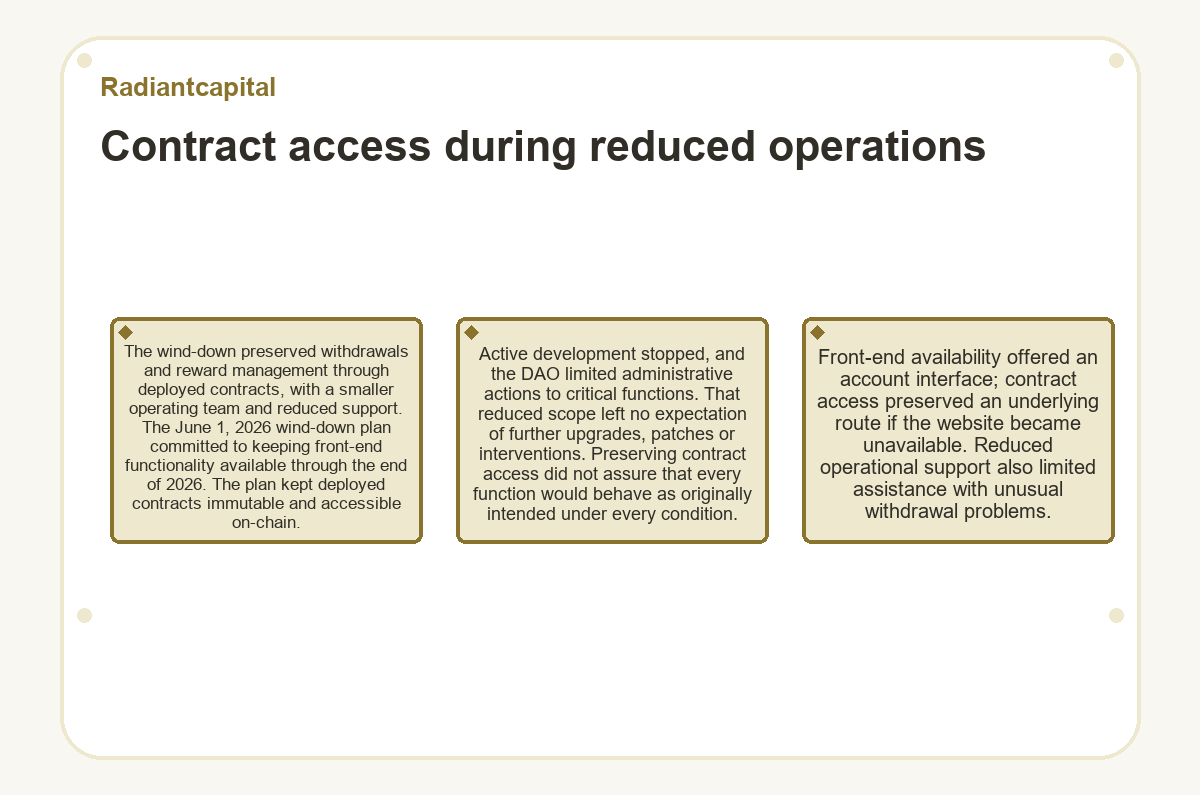
Active development stopped, and the DAO limited administrative actions to critical functions. That reduced scope left no expectation of further upgrades, patches or interventions. Preserving contract access did not assure that every function would behave as originally intended under every condition. Front-end availability offered an account interface; contract access preserved an underlying route if the website became unavailable. Reduced operational support also limited assistance with unusual withdrawal problems.
Platform fee claims and exploit remediation
Exploit remediation concerned affected users and any funds that recovery efforts might return. Platform fee claims concerned earnings from locked dLP. The June 1, 2026 plan retained remediation infrastructure and intended recovered funds for affected users. Its recovery distribution arrangements included claim contracts or Merkl. An ordinary fee receipt did not establish recovery of exploited funds. Distributions of recovered funds remained contingent on successful recovery, while fee claims followed the dLP revenue-sharing mechanism.
Radiantcapital: reader questions
Did the historical 5% dLP threshold represent a fee-claim charge?
The historical rule required locked dLP worth at least 5% of a deposit’s USD value for RDNT-emissions eligibility. It described an incentive requirement, rather than an amount deducted from platform fee revenue. Ending new RDNT emissions removed the reward-related effect of eligibility gating in Radiant V2.
Was the 90-day RDNT vesting period a timetable for redeeming fee assets?
The 90-day maturation period applied to RDNT vesting, while claimed platform fee rTokens followed lending-pool withdrawal conditions. A completed RDNT vest qualified for the full vested RDNT amount. A fee-redemption delay caused by insufficient unborrowed assets followed pool liquidity, so the RDNT vesting clock did not determine when that shortage would clear.
Could the RDNT zap option cash out a platform revenue balance?
The historical RDNT zap used vesting RDNT and produced locked dLP. It avoided the RDNT vesting exit penalty in that vesting flow while creating a locked liquidity position. Fee claims concerned rTokens, and cash-out required redemption of their underlying assets under pool withdrawal rules.
Where did support for fee withdrawals continue after website chat ended?
The June 1, 2026 plan retained best-effort withdrawal support through Discord, Telegram and X while ending website chat immediately. A smaller contributor group remained to assist with withdrawals, repayments and claims. The plan kept documentation and community channels accessible through the end of 2026, with reduced responsiveness, and assigned X an indefinite role for recovery updates.
How did the end-of-2026 access window relate to fee-balance expiry?
The end-of-2026 window concerned front-end maintenance, while the wind-down plan kept deployed contracts accessible on-chain. That access commitment did not specify an expiry date for an individual fee balance. It also did not establish an unlimited claim period or override conditions that applied to particular reward positions.
Could new deposits replenish withdrawal liquidity after borrowing stopped?
Radiant V2 kept lending-pool deposits operational after disabling new borrowing. Deposits therefore remained a possible source of unborrowed assets for withdrawals, alongside borrower repayments. Their continued availability did not establish that a particular pool held enough liquidity for a requested redemption. The relevant condition remained the amount of unborrowed assets available to release.
Is an rToken fee balance enough to fund a direct contract claim?
The sunset’s direct contract route required gas tokens in the wallet that owned the position. Those tokens funded the on-chain transaction; claimable platform revenue described the reward balance. An rToken fee balance alone did not establish a usable gas balance.
Updated -