Radiantcapital dLP locking - Unlock Timing and Exit Choices
Radiantcapital dLP locking committed liquidity tokens until their recorded unlock time under the chosen term. The June 1, 2026 wind-down retained scheduled dLP releases while ending active development and new RDNT emissions. Expiry, renewal settings and liquidity-pool redemption remained separate parts of withdrawing an existing position.
Scheduled withdrawals and a missing interface
Existing holders could inspect an expiring dLP position in Manage Radiant; direct contract access offered an alternative if the interface became unavailable.
The ordinary release route
Manage Radiant displayed lock duration, auto-relock settings and redeemable balances. MultiFeeDistribution handled the locked liquidity tokens and their release after expiry. A position that still awaited its unlock time retained its binding term. The DAO wind-down preserved scheduled releases for existing locks, so stopping development did not bring every withdrawal date forward.
Access through the contract
The V2 sunset arrangements retained access through deployed contracts when the application was unavailable. Direct access depended on the correct MultiFeeDistribution deployment and gas for its network. The owner could release expired LP tokens by submitting the withdrawal from the lock-owning wallet, using its address and setting the withdrawal’s relock option to false. A completed release returned those tokens to that wallet. The June announcement planned front-end access through the end of 2026. Contract access did not promise that every function would work under every condition. Reduced support and the absence of further development limited the assistance available for a malfunctioning interface or contract interaction.
Recorded expiry and the token that was locked
A position’s recorded unlock time determined release eligibility, while its token identity established which liquidity balance the holder had committed. dLP meant dynamic liquidity provisioning and involved liquidity-provider tokens. A directly held RDNT balance represented the protocol token. Creating an LP position and locking its tokens were different operations. The zap route combined liquidity preparation with the locking process.
The V2 lock records distinguished unlockable amounts from amounts that still had time remaining. Multiple locks could carry different expiry times within the same wallet. A total dLP balance therefore did not establish that every token qualified for withdrawal together. Manage Radiant’s redeemable balance concerned the portion eligible for release. A platform fee balance concerned earnings from participation, so it could not establish the expiry of the liquidity tokens themselves.
How did longer locks change the share of fees?
Longer dLP terms increased a balance’s weight in fee allocation while keeping its liquidity tokens committed until a later unlock time.
Duration and pool-wide fee allocation
The historical dLP lock options were one, three, six and twelve months. Their corresponding multipliers were 1x, 4x, 10x and 25x. Fee allocation depended on a position’s weighted dLP amount relative to the pool-wide weighted amount. The revenue available for distribution also affected earnings. The twelve-month multiplier described locking power; it did not multiply the protocol’s revenue or guarantee a particular return.
137 dLP tokens under two lock terms
The binding term followed the confirmed lock choice. For a hypothetical comparison under the historical schedule, assume an unlocked balance of 137 dLP tokens. Compare selecting one month with selecting twelve months while keeping that token amount unchanged.
The one-month option at 1x would have contributed 137 units of fee-allocation weight. The twelve-month option at 25x would have contributed 3,425 units. Both choices concerned the same 137 liquidity tokens. The higher figure expressed greater weight relative to other locks, alongside a longer commitment. Actual earnings would still have depended on available revenue and the other participating balances.
Before confirmation, the holder could change the selected duration without committing those tokens. Once a successful transaction established the lock, its recorded amount and unlock time would show the commitment. That record would show that locking had completed even if subsequent fee revenue were zero. Selecting twelve months would defer withdrawal under the longer term; selecting one month would allow release sooner.
Expiry, auto-relock and removal from the fee pool
Auto-relock allowed an expired dLP position to enter another binding term, while leaving a lock unrenewed exposed it to removal from the fee pool.
Renewing the liquidity commitment
Auto-relock authorized renewal after expiry to maintain participation in the locking pool. Renewal committed the liquidity tokens again and set another unlock date. A holder planning to withdraw at expiry could disable auto-relock beforehand to prevent renewal through that automation. The wind-down left automation contracts callable, although stopping new RDNT emissions removed the RDNT incentive for relock bounties. An enabled setting alone did not establish that renewal had actually occurred.
Leaving an expired lock
The earlier fee system distributed platform revenue linearly over seven days. It allowed disqualification of expired, unrenewed locks and forfeiture of their corresponding seven days of streamed fees to remaining lockers. That consequence concerned the fee allocation attached to the expired participation. Withdrawal of the expired dLP principal followed its own release rules. A holder therefore needed to distinguish pending streamed earnings from the liquidity tokens that had reached expiry.
Fee claims and RDNT vesting beside the dLP lock
Platform fee claims and RDNT reward vesting had their own balances, so neither a claimable reward nor matured RDNT established dLP expiry. The earlier vesting process used a 90-day maturation period for RDNT earnings. That reward clock did not shorten a chosen dLP term. Claiming platform revenue could credit rTokens, which represented interest-bearing balances in the lending markets. Separate early-exit controls concerned RDNT earnings. They did not provide a penalty-based route out of an unexpired dLP lock. The recorded LP unlock time remained the relevant boundary for releasing the committed liquidity tokens.
Expired dLP and the choice between renewal and pool exit
An expired, unrenewed dLP lock allowed release of liquidity tokens, while redemption from the underlying pool concerned a different part of the exit. The ordinary expired-lock withdrawal carried no early-exit penalty. Those tokens could still represent a liquidity-pool position after leaving MultiFeeDistribution. Redeeming that position addressed its underlying assets, using the pool associated with the actual LP token.
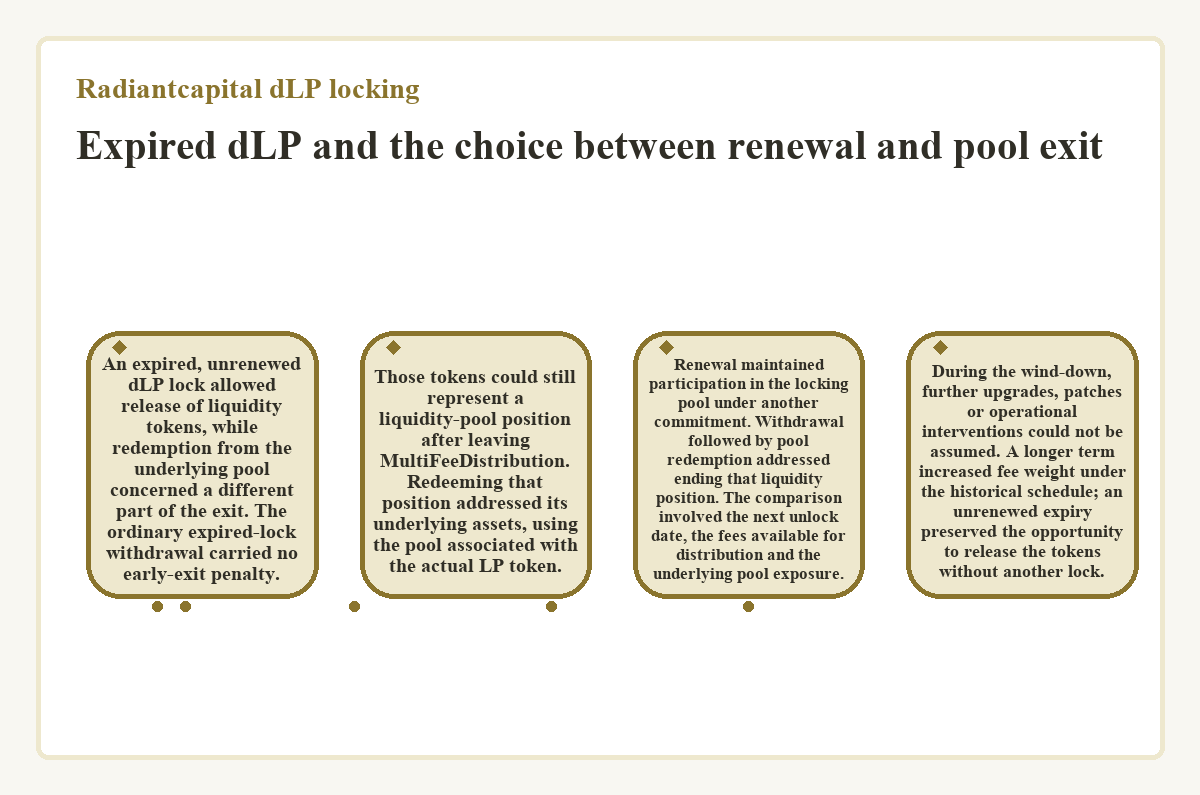
Renewal maintained participation in the locking pool under another commitment. Withdrawal followed by pool redemption addressed ending that liquidity position. The comparison involved the next unlock date, the fees available for distribution and the underlying pool exposure. During the wind-down, further upgrades, patches or operational interventions could not be assumed. A longer term increased fee weight under the historical schedule; an unrenewed expiry preserved the opportunity to release the tokens without another lock.
Radiantcapital dLP locking: what people ask
What portion of protocol revenue went to dLP lockers?
The earlier revenue allocation assigned 60% of protocol revenue to locked dLP. It allocated 15% to operating expenses, 15% to remediation and 10% to the Guardian Fund. Those proportions described division of protocol revenue. They did not represent an APR, a percentage of the holder’s principal or a promise about future earnings.
Why did Base require a different dLP creation route?
Base’s earlier dLP setup used a Uniswap V3 architecture designed to mimic an 80/20 asset ratio. Activating dLP required zapping through Radiant’s front end; Aerodrome’s liquidity NFT was incompatible with Radiant’s dLP system, so that route did not qualify for protocol revenue or RDNT rewards. The setup allowed LP creation through the respective host protocols on Arbitrum, BNB Chain and Ethereum.
Did the 5% dLP threshold impose a withdrawal limit?
The historical 5% threshold governed eligibility for RDNT emissions on deposits and borrows. It compared the USD value of locked dLP with the deposit’s USD value. It did not set a percentage of dLP that could be withdrawn at expiry. Ending new RDNT emissions during the wind-down also removed the reward purpose of that eligibility test.
Could vesting RDNT move into locked dLP without an exit penalty?
The earlier vesting zap converted all currently vesting RDNT across the wallet’s vesting periods into locked dLP without the RDNT exit penalty. It paired RDNT with the required ETH or BNB amount. That conversion created a liquidity commitment instead of delivering freely withdrawable RDNT. The new dLP position then followed its lock term. The historical emission benefit of this route did not continue after new RDNT emissions ended.
Did locking 15% dLP cover losses from an underlying liquidity pool?
Guardian protection excluded impermanent loss, ordinary market-price losses and failures in third-party protocols, even for holders meeting its historical dLP eligibility threshold. That threshold required dLP equivalent to at least 15% of the deposited amount. Remediation concerned qualifying protocol incidents and depended on the Guardian Fund’s available capital, applicable scope and governance rules.
Was the end-of-2026 website plan a deadline for withdrawing dLP?
The announced end-of-2026 front-end access window did not set every dLP position’s withdrawal date. Existing locks retained their release schedules under the maintenance arrangements, which also preserved access to deployed contracts. The end of that website access window did not accelerate an unexpired lock or replace its recorded unlock time.
Would claiming platform fees trigger an early-unlock penalty?
The earlier dLP fee-claim mechanism allowed claims of accrued platform fees without a penalty. A fee claim concerned earnings and did not release the locked liquidity tokens. RDNT early-vesting exits had separate penalty rules. Claiming fees, withdrawing RDNT earnings and releasing dLP principal therefore concerned different balances and restrictions.
Where could users ask about dLP unlocks after website chat closed?
The June 1, 2026 plan retained support through Discord, Telegram and X after ending website chat immediately. A smaller contributor group was to assist with withdrawals, repayments and remediation questions on a best-effort basis. Reduced responsiveness and limited operational intervention meant that access to a support channel did not promise a prompt fix for an unlock problem.
Updated -